Tata Sierra vs Kia Seltos Comparison: Price, Features, Engines & Which SUV Makes More Sense?
5 min read
The Indian mid-size SUV segment has entered one of its most competitive phases ever. With the all-new Kia Seltos (second generation) officially launched and the iconic Tata Sierra making a long-awaited comeback, buyers are now presented with two very different interpretations of what a modern SUV should be.
While both SUVs sit close to each other on the price ladder and target similar budgets, they are fundamentally designed for very different buyer mindsets. One prioritizes technology, refinement, and urban usability. The other leans into size, capability, and emotional appeal.
This comparison breaks down pricing, engines, features, technology, safety, and real-world positioning to help you decide which SUV makes more sense for your needs.
Design Philosophy: Modern Urban vs Rugged Revival
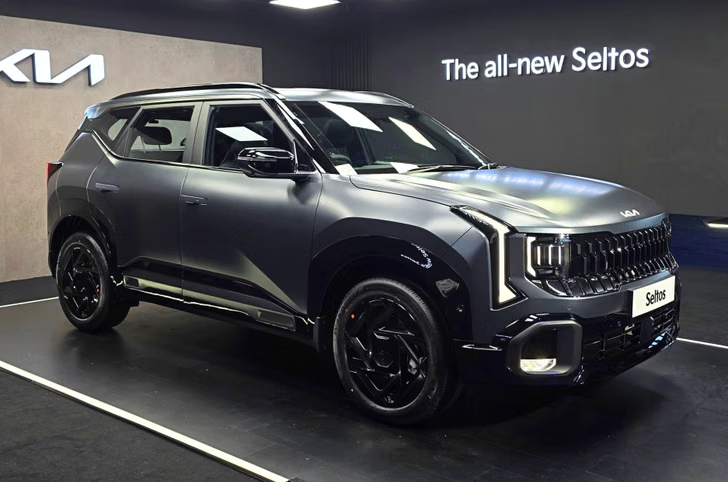
Kia Seltos: Sharp, Urban, and Contemporary
The second-generation Kia Seltos adopts Kia’s latest ‘Opposites United’ design language, giving it a sharper and more premium visual identity.
Key design highlights include:
- Wide grille with vertically stacked LED DRLs
- Flush-fitting door handles
- Connected LED tail lamps
- 18-inch alloy wheels
- Clean, aerodynamic proportions
The Seltos looks unmistakably urban-focused, designed to appeal to buyers who want a stylish SUV that blends easily into city life while still looking premium.

Tata Sierra: Boxy, Bold, and Purposeful
The new Tata Sierra takes a completely different approach. It revives the iconic Sierra silhouette with a retro-modern design that prioritizes presence and proportions.
Key design highlights include:
- Boxy stance with upright SUV proportions
- Reimagined Alpine glass roof
- Full-width LED DRLs and tail lamps
- 19-inch alloy wheels (segment-largest)
- Contrasting black floating roof on all colours
The Sierra looks larger, more rugged, and unmistakably SUV-like, appealing to buyers who want something that feels substantial and distinctive on the road.
Interior & Cabin Experience: Tech Lounge vs Digital Command Center
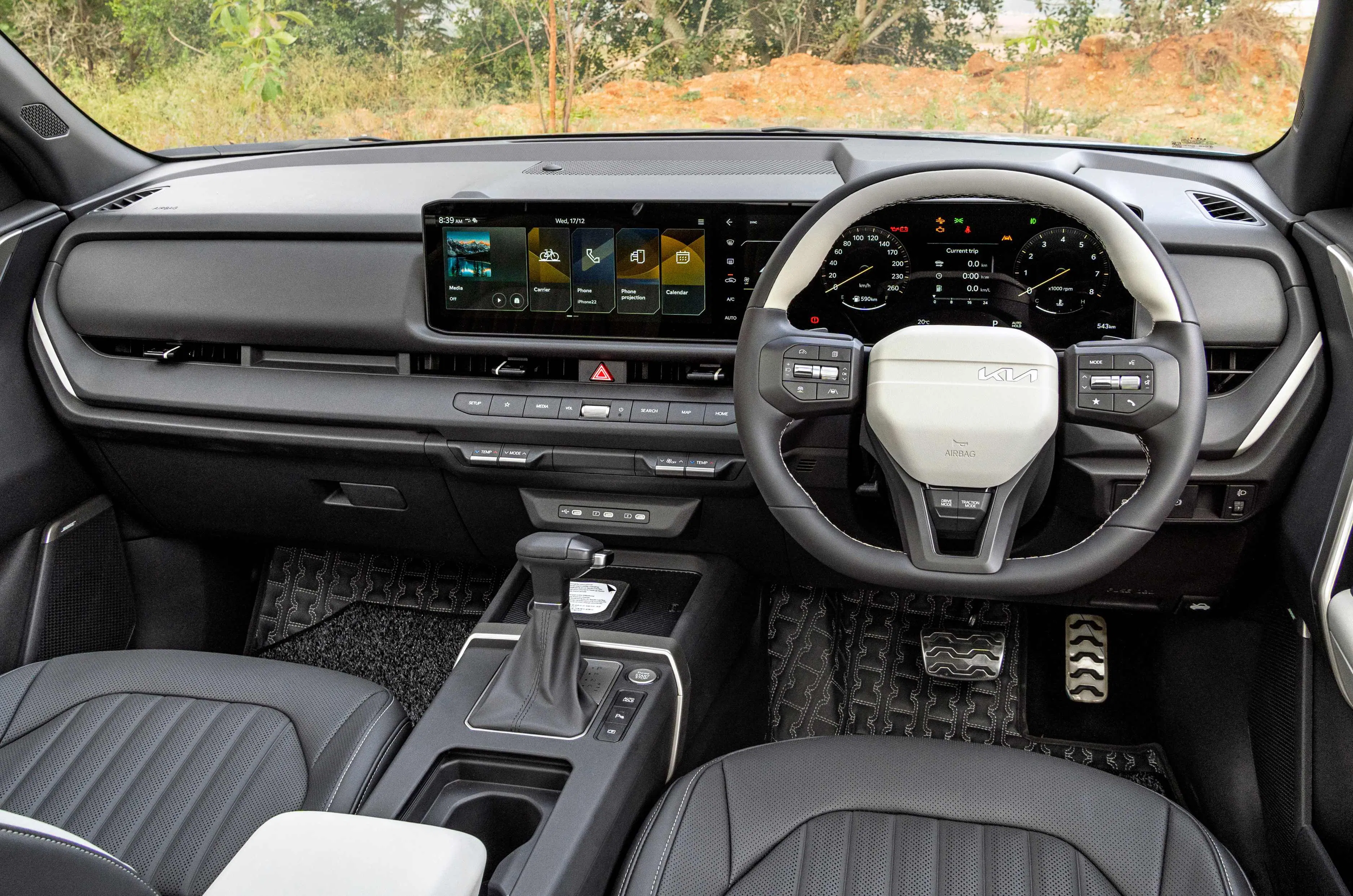
Kia Seltos Interior
The Seltos focuses heavily on refinement and ease of use.
Key interior features:
- Dual 12.3-inch integrated displays (infotainment + driver cluster)
- Wireless Android Auto & Apple CarPlay
- 8-speaker Bose sound system
- Panoramic sunroof
- Ventilated front seats
- 64-colour ambient lighting
- Dual-zone climate control
- 10-way powered driver seat with memory and relaxation mode
The cabin feels modern, well-finished, and intuitive, especially for daily commuting and long highway drives.
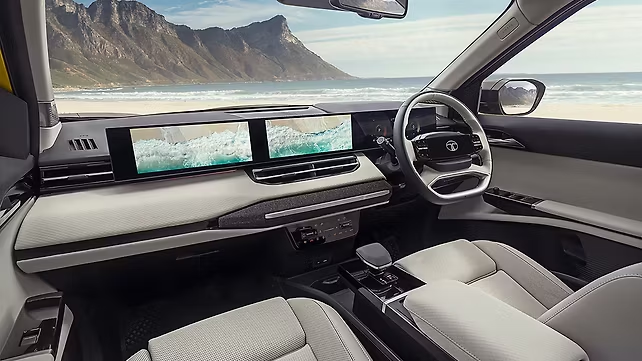
Tata Sierra Interior
The Sierra raises the bar on visual drama and feature density.
Key interior features:
- Triple-screen dashboard layout (driver, infotainment, passenger)
- 12-speaker JBL sound system with soundbar
- Head-Up Display (HUD)
- Panoramic sunroof (claimed largest in segment)
- Level 2+ ADAS
- Powered driver seat with memory
- Dual-zone climate control
- 360-degree camera
- Electronic parking brake
- Connected car tech with extensive vehicle controls
The Sierra’s cabin feels experimental, bold, and premium, clearly aimed at buyers who want the latest technology and a sense of occasion every time they drive.
Engine & Powertrain Options: Accessibility vs Capability
Kia Seltos Engine Line-up
Kia offers a broad powertrain spread right from lower trims:
- 1.5L NA Petrol – 115 PS
- 1.5L Turbo Petrol – 160 PS
- 1.5L Diesel – 116 PS
Transmission options include:
- 6-speed Manual
- IVT (CVT)
- 6-speed iMT
- 7-speed DCT
- 6-speed Automatic
The Seltos stands out for offering turbo-petrol options at relatively lower price points, making it attractive for performance-oriented buyers on a budget.
Tata Sierra Engine Line-up
The Sierra focuses on breadth and capability rather than early accessibility.
- 1.5L NA Petrol – 105 PS
- 1.5L Turbo Petrol (Hyperion GDi) – 158 PS, 255 Nm
- 1.5L Diesel – 116 PS, 260 Nm
Transmission options include:
- 6-speed Manual
- 6-speed Torque Converter Automatic
- 7-speed DCT (NA petrol)
A key differentiator is AWD availability, expected on top variants—something the Seltos does not offer.
Pricing & Value Proposition
Kia Seltos Pricing
- Starts at ₹10.99 lakh
- Goes up to ₹19.99 lakh
- Aggressively priced at the entry level
- Turbo petrol and automatic options available early in the range
Tata Sierra Pricing
- Starts at ₹11.49 lakh
- Expected to go up to ₹21 lakh+
- Priced slightly higher across comparable trims
- Justifies premium through size, AWD, and feature density
Verdict on Pricing:
The Seltos clearly wins on entry-level affordability, while the Sierra positions itself as a premium, feature-heavy SUV.
Safety & ADAS
Both SUVs offer:
- Six airbags as standard
- ABS with EBD
- ESC
- ISOFIX mounts
- 360-degree camera (higher trims)
- Level 2 ADAS
The Sierra pushes further with Level 2+ ADAS, while the Seltos focuses on a well-integrated, user-friendly ADAS setup.
Who Should Buy What?
Choose Kia Seltos If:
- You want a refined, tech-forward urban SUV
- You prefer smooth city and highway driving
- You want turbo-petrol performance at lower prices
- Daily usability and reliability matter most
Choose Tata Sierra If:
- You want a bold, larger, more commanding SUV
- You value features, technology, and interior innovation
- AWD and long-term ownership appeal to you
- You want something emotionally distinctive
Final Verdict: Two SUVs, Two Clear Directions
The Kia Seltos remains the benchmark for urban-friendly, tech-savvy mid-size SUVs, while the Tata Sierra redefines the segment by bringing size, capability, and premium innovation into the conversation.
Neither is objectively better—each excels in its own direction. The real winner is the buyer, who now has more choice than ever in one of India’s most important SUV segments.