2026 Honda City Launched In India: The Sedan That Refuses To Fade Away Gets Its Most Important Update Yet
5 min read
In an Indian market increasingly dominated by SUVs, the survival of the sedan has become less about volume and more about identity.
And no car represents that better than the Honda City.
For over two decades, the City has occupied a unique space in the Indian automotive landscape. It has never been the cheapest option in its segment, never the most aggressively marketed, and rarely the flashiest. Yet generation after generation, buyers have continued to return to it for one reason — consistency.
The Honda City has built its reputation on delivering a polished ownership experience that feels mature, reliable and quietly premium without trying too hard.
Now, Honda Cars India has launched the 2026 Honda City facelift at an introductory price of Rs 12 lakh (ex-showroom), bringing the most comprehensive update to the fifth-generation sedan since its debut in 2020.
And this update feels far more significant than a routine facelift.
Because at a time when many manufacturers are gradually shifting focus away from sedans, Honda appears to be doing the opposite — investing further into what still makes the City relevant.
The New Honda City Looks Sharper Without Losing Its Identity
The biggest transformation on the 2026 City is at the front.
Honda has completely redesigned the fascia, giving the sedan a more contemporary and premium appearance while still retaining the understated elegance that City buyers traditionally prefer.
The new connected LED headlamp setup immediately changes the character of the car. The slimmer lamps now feature a dual-element DRL signature connected by a light bar running across the grille, giving the City a wider and more modern visual stance.
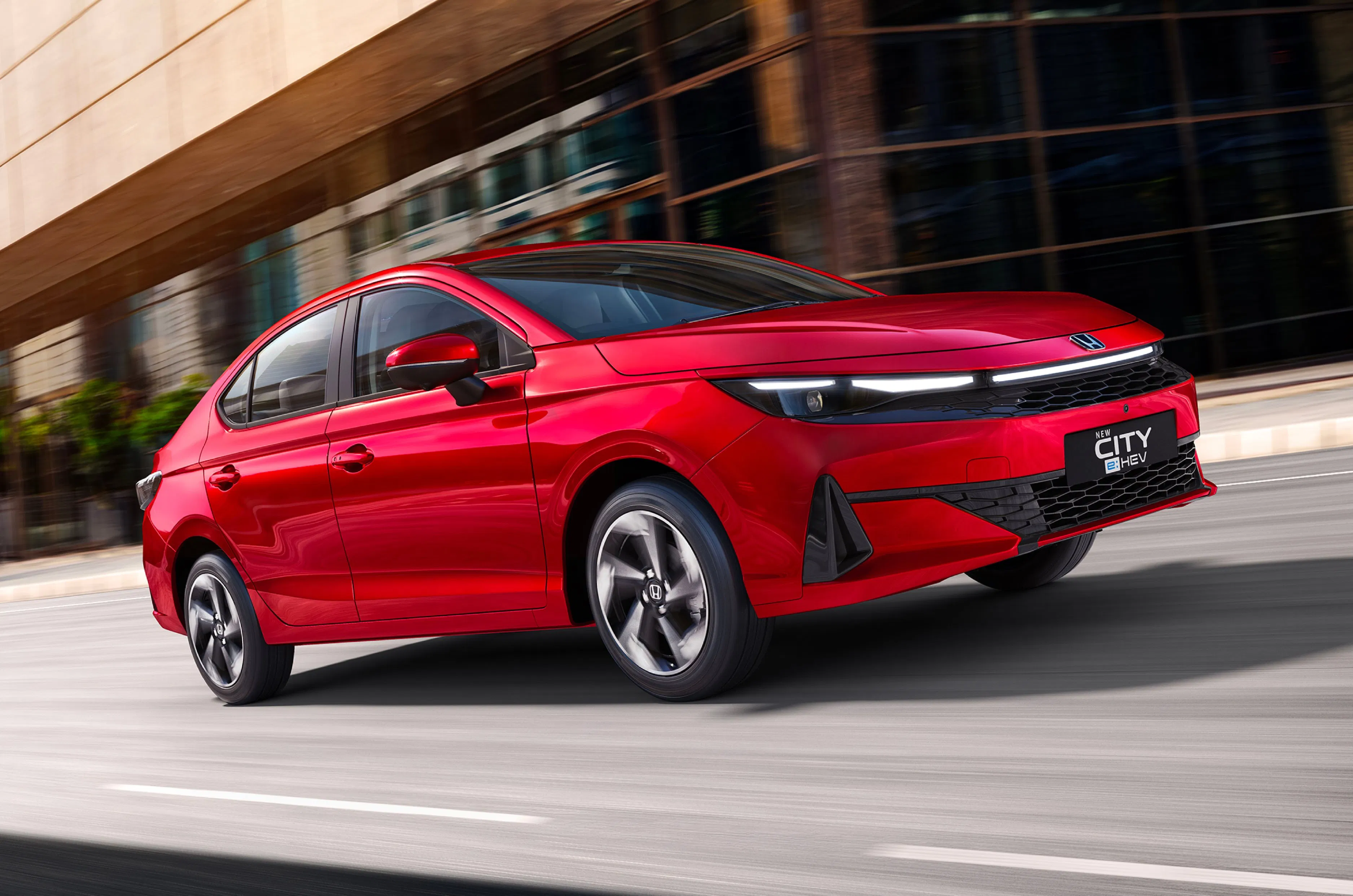
The previous chrome-heavy treatment has been toned down significantly. Instead, the new honeycomb-pattern grille and body-coloured upper section create a cleaner and more sophisticated appearance. The bumper has also been redesigned with sharper triangular elements and a wider lower intake that adds more visual width to the sedan.
What Honda has done well here is restraint.
Unlike many modern facelifts that overcomplicate the design with excessive cuts and aggressive detailing, the new City still feels clean and mature — exactly what many sedan buyers continue to appreciate.
In profile, the silhouette remains familiar, which is not necessarily a bad thing. The City’s proportions have always been one of its strengths. Honda has instead focused on subtle improvements like newly designed dual-tone 16-inch alloy wheels and revised detailing.
At the rear, the updated bumper and smoked tail-lamp treatment give the sedan a cleaner and slightly sportier finish without disrupting its overall design balance.
The Cabin Now Feels More In Line With Buyer Expectations In 2026
While the exterior redesign is substantial, the interior changes focus more on improving daily usability and perceived modernity.
The biggest update is the new 10.1-inch touchscreen infotainment system, which now sits more prominently on the dashboard and supports wireless Android Auto and Apple CarPlay.
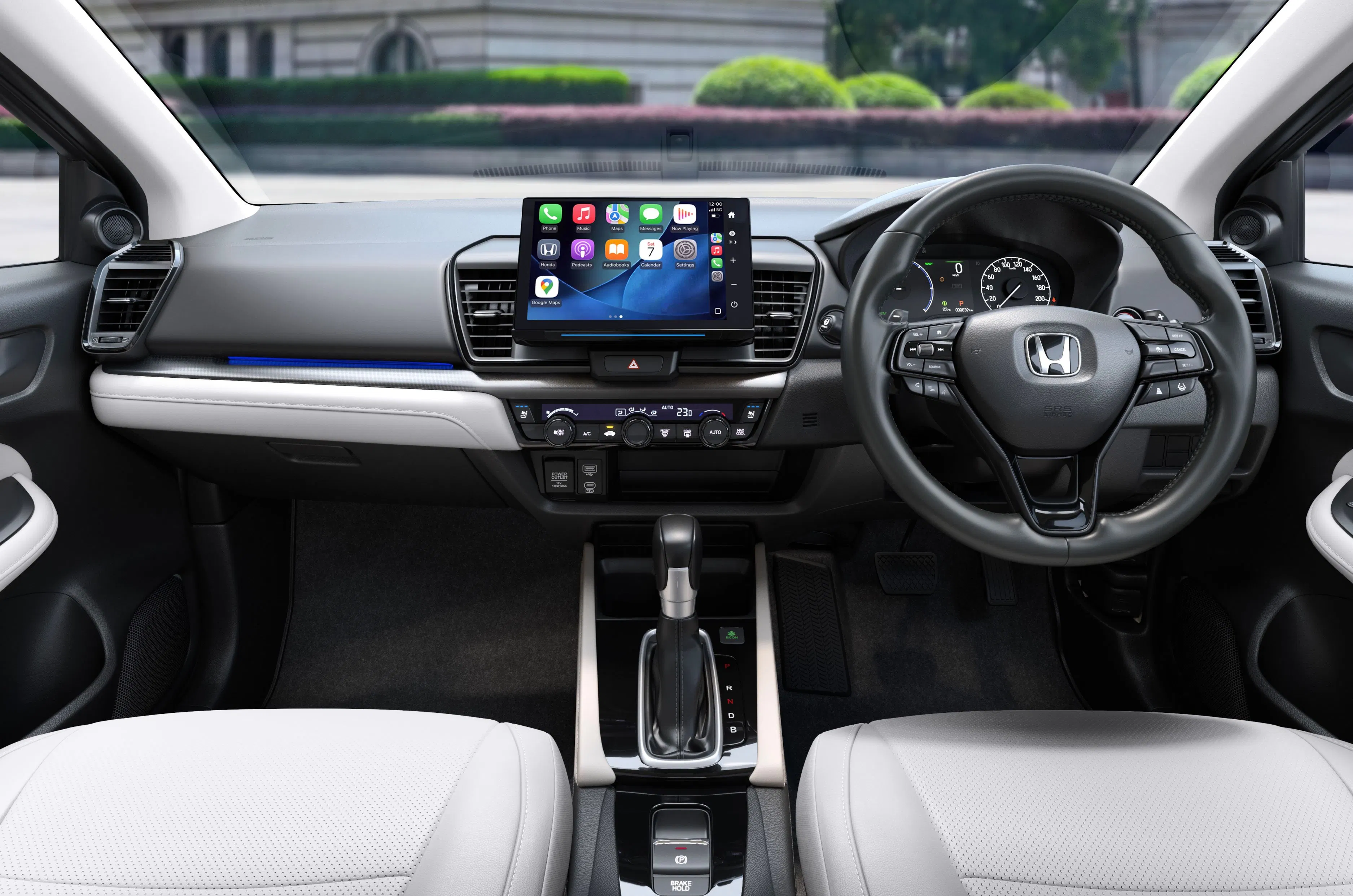
Importantly, Honda has resisted the temptation to remove physical controls entirely. The City still retains tactile HVAC buttons and functional switchgear, something many buyers genuinely appreciate in real-world usage despite the growing industry obsession with touch-heavy interiors.
The feature list has also expanded meaningfully.
Ventilated front seats finally make their way into the City, addressing one of the most requested additions for Indian conditions. Honda has also added a 360-degree camera system, wireless charging, ambient lighting, connected car technology, an 8-speaker audio setup and an electric parking brake.
The rear sunshade continues as well, reinforcing the City’s long-standing reputation as a sedan that still prioritises rear-seat comfort — something increasingly rare in the segment.
The Honda City Still Understands What Sedan Buyers Actually Want
One of the reasons the City has survived while many sedans have struggled is because Honda has never tried to transform it into something it is not.
The City is not positioned as a sporty performance sedan like the turbocharged Volkswagen Virtus or Skoda Slavia. It is not aggressively styled like the Hyundai Verna either.
Instead, the City continues to focus on refinement, space, visibility, driving smoothness and long-term ownership comfort.
That philosophy continues unchanged in the 2026 update.
Under the hood, the City carries forward the same 1.5-litre naturally aspirated petrol engine producing 121hp and 145Nm. Transmission options continue with a 6-speed manual and a 7-step CVT automatic.
And honestly, that may be exactly what many buyers still want.
In an era where smaller turbocharged engines dominate spec sheets, the City’s naturally aspirated engine continues to deliver something increasingly uncommon — linear performance and smoothness without complexity.
For buyers prioritising daily drivability, reliability and refinement over outright acceleration numbers, the City still makes a compelling argument.
The Hybrid Continues To Be One Of The Most Underrated Cars In India
Honda has also retained the City e:HEV strong hybrid, available exclusively in the top ZX+ trim.
The hybrid system continues with the 1.5-litre petrol-electric setup producing 126hp and 253Nm combined, paired with an e-CVT transmission.
What remains remarkable is its claimed fuel efficiency figure of 27.26kpl.
In real-world ownership terms, the City Hybrid continues to occupy a very unique position in the Indian market. It offers EV-like city driving characteristics without requiring charging infrastructure, range planning or behavioural changes from the buyer.
And in 2026, that still matters.
Honda is also now offering a 5-year warranty on hybrid components, which should further improve confidence among buyers considering electrified options without committing fully to EV ownership.
Safety And ADAS Continue To Be A Strong Focus
Honda has retained the City’s Level 2 ADAS suite, which includes adaptive cruise control, lane keep assist and collision mitigation functions.
The sedan also continues with six airbags, hill-start assist, rain-sensing wipers and Honda’s lane-watch camera system.
While some rivals may offer more dramatic feature lists on paper, the City’s approach still feels more cohesive and usability-focused rather than feature overload for showroom appeal.
Variant-Wise Pricing
The 2026 Honda City is available in four trims: SV, V, ZX and ZX+.
The introductory ex-showroom prices are as follows:
1.5 Petrol Manual
SV – Rs 12 lakh
V – Rs 13.30 lakh
ZX – Rs 15.26 lakh
ZX+ – Rs 16.15 lakh
1.5 Petrol CVT
V – Rs 14.30 lakh
ZX – Rs 16.26 lakh
ZX+ – Rs 17.15 lakh
1.5 Strong Hybrid e:HEV
ZX+ – Rs 21 lakh
Why The 2026 Honda City Still Matters
The Indian sedan market is no longer driven by mass demand.
It is driven by conviction.
And that is precisely why the Honda City continues to matter.
For buyers who still value driving comfort over exaggerated SUV stance, cabin openness over visual aggression and long-term refinement over short-term excitement, the City remains one of the strongest choices in the segment.
This facelift does not reinvent the Honda City.
It simply modernises what already worked — and perhaps that is exactly the right approach.
For buyers considering the 2026 Honda City, detailed variant-wise prices, on-road quotes, exchange offers and hybrid availability can vary significantly between dealerships and cities.